
From Ancient Shadows
Moments in the Flow: the Spotlight Finds a Sumerian Priestess

Hello again,
My recent post Spotlight on the Hidden Women discussed the current trend of books, articles, and exhibits that brought the previously unknown lives and contributions of women into our awareness.
I had missed one and posted a Note to include the focus of a current film on another unknown woman. “Hamnet” is the story of the death of Shakespeare’s son. For the first time in my knowledge, we met Hamnet’s mother…Shakespeare’s wife, Agnes. She is more commonly known as Anne Hathaway (In pronunciation Agnes in her time sounds more like Annes). And in a ‘first time ever’ Jessie Buckley, who played the part, won all the awards for Best Actress.
So, I couldn’t help but notice when an article appeared on an unknown woman from the ancient land of Ur, a Sumerian city. Perhaps war happening now in the area where she lived (Iraq) ignited someone’s research this week. And this brought me my awareness of the first human to ever write a history of the world until their time. And that person was a woman.
And her work began because, like now, there was a war which had captured these cities and created a new formation: the world’s first known Empire.
From The Article on Enheduanna*
“Before Homer. Before the Bible. Before the Iliad, the Odyssey, the I Ching, and the Book of the Dead. Before any of the texts we think of as the foundation of human literature — there was a woman in a city called Ur, pressing words into wet clay, and she did something that had never been done before.
She signed her name.
Not as a scribe copying someone else’s words. Not as an anonymous hand recording an inventory of grain or a list of laws. She signed her name as a creator — as the person who had made something that had not existed before she made it. She wrote it plainly, in the clay, for anyone who came after to read:
“The compiler of the tablets is Enheduanna. My lord, that which has been created here — no one has created before.”
Four thousand three hundred years later, we still know her name. And almost no one has heard it.
Her full name — Enheduanna (en-hay-doo-AN-na) — translates roughly as “ornament of heaven.” She lived around 2300 BCE in what is now southern Iraq, in the ancient Sumerian city of Ur. She was the high priestess of Nanna, the moon god whose temple dominated the city, whose ziggurat rose in stepped stone tiers above the flat plain of the Mesopotamian river valley. She was also the daughter — or at minimum the designated heir — of Sargon of Akkad, the man who built the world’s first known empire by conquering and unifying the city-states of both Sumer in the south and Akkad in the north into something that had never existed before: a single political entity spanning hundreds of miles, held together by military force, administrative infrastructure, and — crucially — religion.”
Sargon knew that conquered people could not be forced to believe in the good of their new arrangement, but they could be wooed into peace and assimilation by hearing beautiful poems and religious songs, especially ones that emphasized their shared religion. He gave his daughter Enheduanna the status of High Priestess and sent her to Ur.
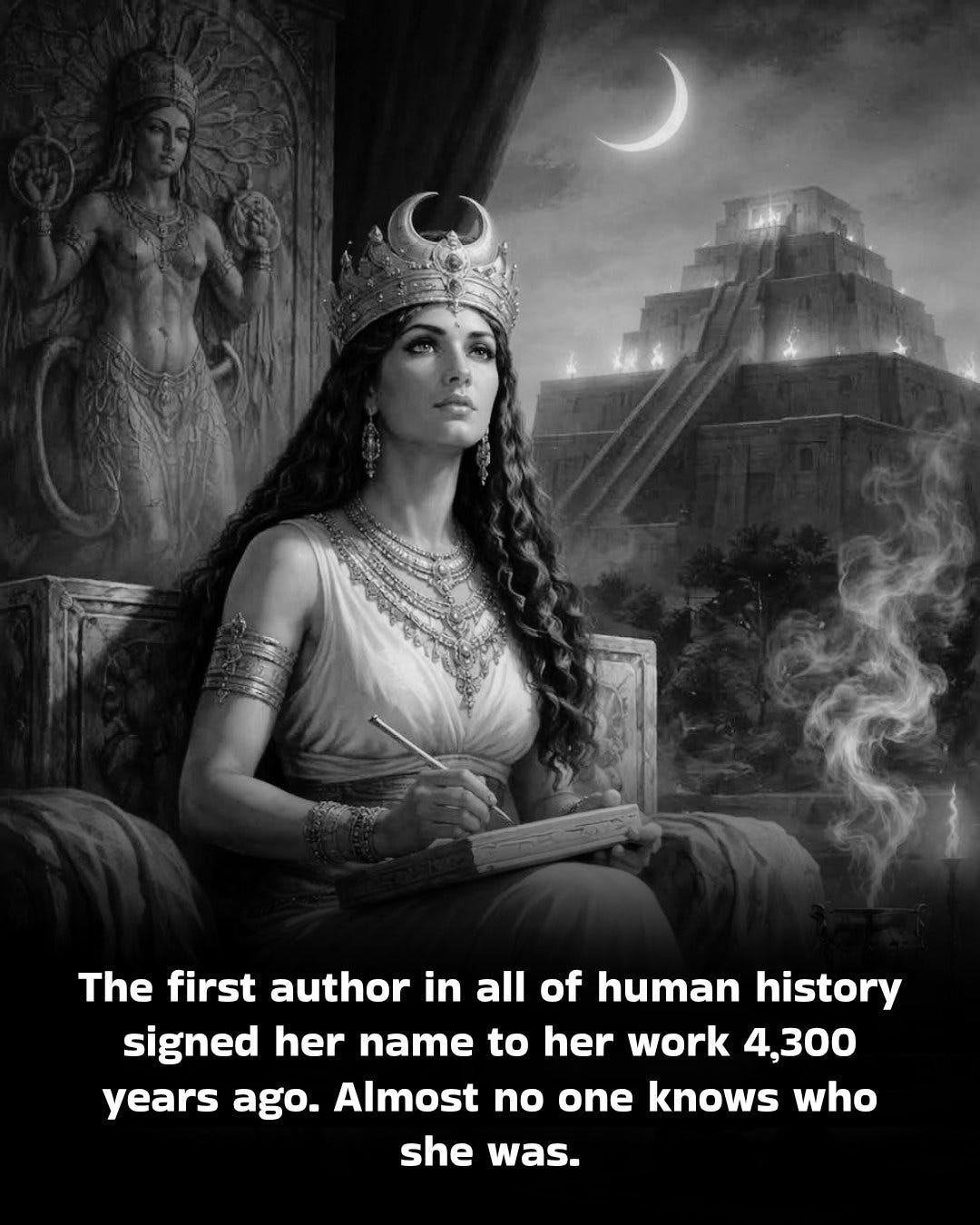
There she wrote hymns filled with emotion about her worship of Inanna, something people could relate to. And she wrote in a way that had never been done before, in first-person and using her own name. She was the first to sign the clay tablets.
Then something happened that made her more unique—the telling of a later uprising and her loss of status. She wrote what happened as a first-hand, personal experience of this war and its effects on her. “The poem she wrote during and after the exile — later called The Exaltation of Inanna, the oldest poem in the world attributed to a named author — is a work of theology, autobiography, politics, and prayer simultaneously. It praises Inanna’s power in language of startling vividness.”
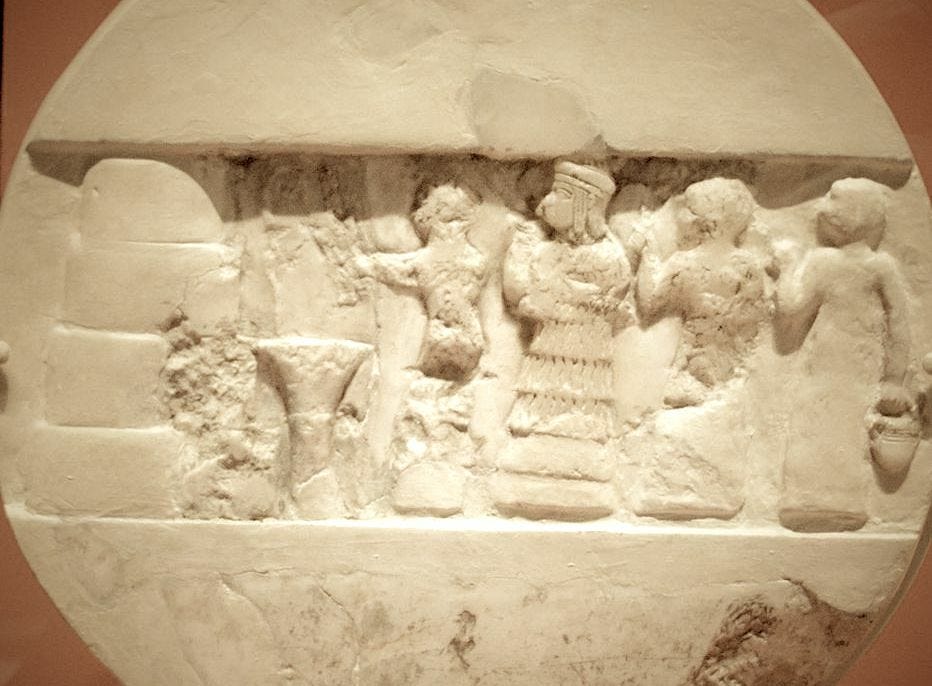
But the focus on her faded as the eras moved on…then “She was rediscovered in the modern era almost by accident. Archaeologists excavating Ur in the 1920s found a calcite disk roughly the size of a dinner plate. On it, carved in relief, stood a woman in ceremonial robes, slightly larger than the other figures around her, overseeing a ritual offering. On the back, an inscription identified her: high priestess, wife of the god Nanna, daughter of Sargon. When scholars matched the inscription to fragments of clay tablets found at Nippur and Ur, the connection was made. Here, preserved in stone and clay across four millennia, was a single coherent figure — a real woman, with a name and a face and a voice.”
The disk is at the Penn Museum in Philadelphia (PA). Tablets are found in many other museums around the world. But what strikes me most is, as the article says, everyone who signs their name to their written words can pay homage to the first: A woman from 2300 BC.
For more information and photos visit the BBC Article, “Enheduanna: the world’s first named author” and this page of the Morgan Library & Museum; She Who Wrote which has a wonderful video I just watched after writing this post and searching her name to find more resources.
In what is yet another irony for me, I grew up in NYC and had never visited the Morgan Library & Museum but felt like I wanted to see this when I visited NYC last May. Plans while I was there didn’t take me that way, but I might have seen this then and remembered to include her in the first article on hidden women.
See you next time!
*Legends of the Past “History is not dead; it lives in the legends of the past.” Also ironically, there are no references or bio to learn the name of this writer.
Outstanding, I had never heard of Enheduanna. Fascinating article
I was familiar with Enheduanna and her Exaltation but didn't realize her status as the first known author. Bravo to you!