
Ceridwen Myth Reimagined—Part Two
Moments in the Flow—The Education of the Bard

Hello again,
If you’ve just arrived on my page, some background on this post can be found in The Myth of Ceridwen, Part One.
Here, by way of answering any questions that may come up for Readers, I’d like to say I know that retelling a famous myth may be seen as a sacrilege and I may even be accused of ‘cultural appropriation.’ But I would say, as wonderful and interesting as the current version of the Birth of Taliesin may be, this tale is told in fully Christianized times from the male point of view and it’s very likely that the Goddess of the Cauldron has been changed from and earlier Celtic view. This is certainly possible as the pre-Christian Druid, especially the Priestess, was demonized in later tellings, especially in the early Arthurian Legends.
I learned more about this when I was receiving the inspiration for the life of Anwen, a Druid Priestess in the late 5th Century CE Wales. Christianity had already arrived and mixed with the culture as a Celtic Christian Church. The influence of the Druids remained in the countryside, but they would gradually ‘disappear’ into the population, not long before the Roman Church demanded allegiance to the Roman Pope.
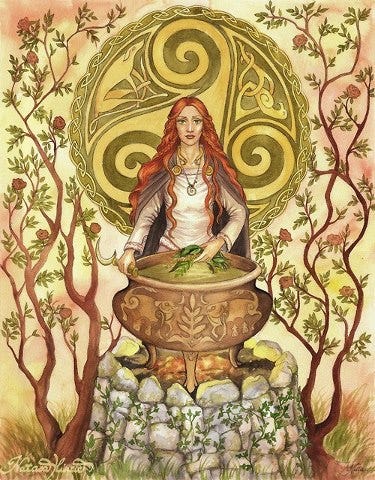
An example that remains of a Cauldron Goddess is the Irish Great Mother Goddess, Brigid. Her Cauldron brought Inspiration from the Otherworld. One of her gifts, along with healing, and metallurgy, was Poetry. Revered in the Bardic times, the Welsh name Ceridwen (Ke RID’ wen) translates to ‘Fair Blessed Poetry,’ and this is one of the reasons I feel she may have been more like Brigid in older times.
As for cultural appropriation, my Welsh ancestors came to the US in the mid-late 1800s so they were living in Wales for both the writing of the 11th or 12th century Mabinogion and the time before, when the Druids had their way of seeing things. That era, then, is part of my cultural lineage that lives on in my blood and bones. And it was this ancestral knowledge that made me able to bring through the life of a Druid Priestess, a subject I had never studied and about which little was known.
If I wrote about the culture of Wales after the mid-1800s that would be beyond my ancestral memory and would qualify me for a cultural appropriation label.
The Goddess Changes
My point of view is that in the Chrisitan culture’s tellings, the goddesses of the ancestors changed. They become human women with some powers, but also with flaws and helpless, sorrowful moments. Ceridwen in the current tale is the wife of a wealthy landowner. She is an ‘enchantress’ with knowledge of herbs. She has a lovely daughter but an ogre for a son who she seeks to give some advantage with a special brew of herbs that will grant him knowledge of all things. Three drops will hold this, and the rest will be poison.
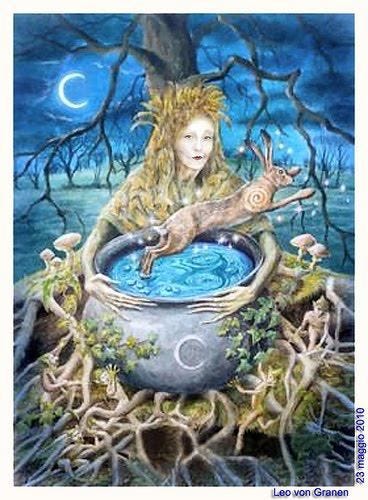
When the three drops accidentally go the young boy, tasked with stirring the cauldron for a year and a day, she becomes a dangerous, vengeful figure. The chase begins as the boy shapeshifts into a hare and she into a hound. The chase ends when, as a chicken, she eats him as a piece of grain. She later gives birth to him and it’s said she intended to kill him at that moment, though his beauty stops her. (The theme of killing babies is also in the myth of Rhiannon. I wonder about that and must research this at another time.)
What I wish to do now is something similar to what we find in the Revealing the Druid Legacy series. That is to convey the Welsh Cauldron Goddess as she was seen before the 11th and 12th centuries. I have found some symbolism emerge in the current way of telling the Birth of Taliesin. This is where we can see Ceridwen as a Goddess who challenges the impatient student to go further in knowledge so he will reach his highest level of talents as a Bard.
The Bardic Training
In our culture today, we see a one-year (or less) certificate course producing practitioners of many esoteric and healing subjects. Long ago, I spent every week for over a year with my teacher before I felt I should be practicing Astrology.
I remember teaching a two-day class in Aromatherapy in the 1990s and a week later, a student showed me his new business card where he called himself an Aromatherapist. The Professional level classes I taught were a far longer process than an introduction to the subject. And I have learned that no matter how long I have been in a profession, there is always more to know.
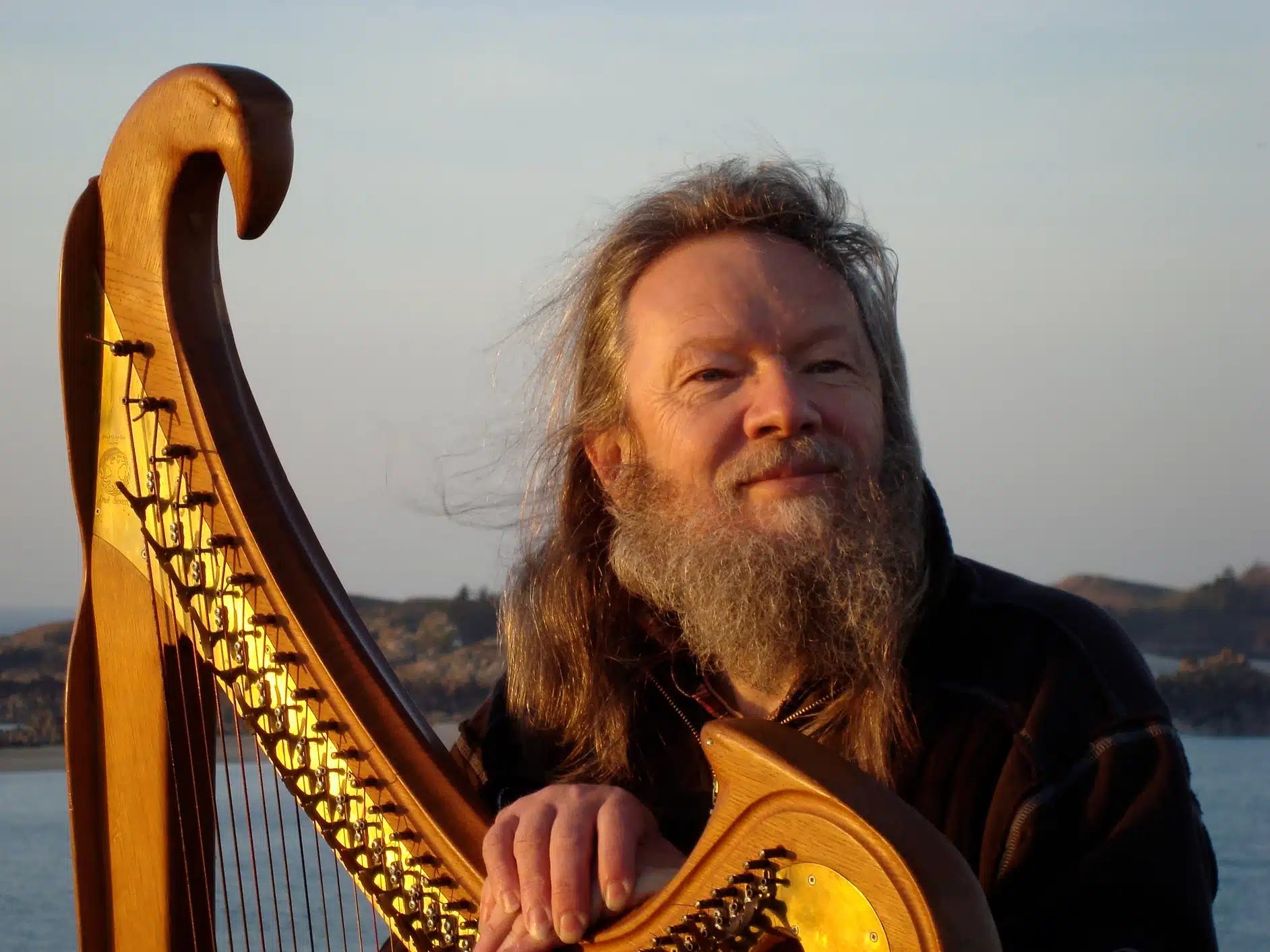
The Druid training for Priests and Bards was a long process. Some say 12 years of study (some say more) were required to become a Bard.* This was because a major part of the Bard’s duties was to recount the histories and the tribute songs of the Ruler and his family. Memorization of these and all the other festival songs had to be accomplished and demonstrated, along with proficiency at the harp with all the tunes appropriate for each of the individual tellings.
When it came to the seasonal festival songs and the tales of the gods and goddesses, along with the pure enjoyment of the entertainment, the words had to be precisely the same and the images delivered in a powerful way to instruct, enlighten, and uplift their audience. Hearing the song each year the listener receives new awareness of meanings as time passes and finds useful applications at the different stages of their own life experience.
The Power of Words and Sound
When we read Anwen’s training (beginning in Book Two, Priestess of the Realms and continuing into Book Three, Priestess of the Prophecy) we find an emphasis on the power of words and sound.
The Bard had to know how to use his voice to best result, the nuances required at certain moments, the power and meaning of the words he sang, and apply all of this to create the effects desired for his audience.
Most important of all was that the Bard bowed to Goddess and the Inspiration received from the Otherworld through Her Cauldron. This was especially true while he composed a song of his own. The Bard knew if his song was created with his own ego, the desired effects could not be achieved.
When the Druid Priests and Priestesses were no longer seen, the Bards went on into the later medieval time because of their entertainment value and tribute songs in the Royal courts. But the connection to the Goddess was broken, and the Bard would evolve into the Troubadour.
Are There Bards Today?
The later medieval story of the “birth of Taliesin, the greatest of all Bards” does show him coming through the human enchantress, but it does not reflect this Bardic process. Just as it is in the life of Jesus, there are years missing before his actual Bardic work begins. We may imagine that Taliesin is doing those studies required to master his art, just as some claim Jesus traveled to study with the wise men of other cultures.
And since my inspiration led me to convey more background today, my reimagining of the Ceridwen Myth will have to be in another post…Part Three. I think it’s important to know about the teachings from the past because we have forgotten them today. And though we forgot, that doesn’t mean the power of voice, words, and sounds is no longer there. We find the neo-Druid teachings include the position of the Bard. OBOD is one society that includes this in their name: Order of Bards, Ovates, and Druids.
While you wait for the next piece on this topic, you might ponder the effects of sound and words in the music of our culture. What do you think about it? An example of a modern version of the traveling Bard, or more accurately, Troubadour would be Bob Dylan. Can you find others?
I do hope to deliver the reimagined myth Part Three on Friday.
As always, I invite you to share or restack this post so that others might find information that they would enjoy. I also invite your questions and comments. A way to show appreciation that allows you to do a one time donation of your choice is to Buy Me a Coffee. ✨☕✨
Thank you! I’ll see you next time.
Thanks for sharing. I was very impressed by this passage from your text above: "Most important of all was that the Bard bowed to Goddess and the Inspiration received from the Otherworld through Her Cauldron." I see a remarkable similarity to the opening lines of the ILIAD: "Sing, Muse, [of] the wrath of Akhilles." Here the speaker (in this case, the poet, whom we also identify as Homer) knew that HE could not tell the tale; only the divinity (i.e., Muse) could do it justice.