
Blaming Venus
Moments in the Flow…Did She Start the Trojan War?!?


Hello again,
I was browsing through Substack Notes and came upon someone sharing an opinion about the Judgment of Paris which sparked the tragic Trojan War. She blames the war on the offer of Venus, who knows how to manipulate men, and that’s what inspired me to create this examination. For those not familiar with the tale, and even those who are, I will convey a short summary of the highlights.
The Judgement of Paris
In the Greek Myth, Zeus held a wedding party and did not invite Eris. She is the sister of Mars and commonly known as the Goddess of Discord. Of course, this made Eris angry and in something like our fairytale, Sleeping Beauty, she would find a way to cause problems.
Her method was to create a difficult competition by throwing a golden apple marked “to the Fairest One” into the gathering. Three Goddesses were involved, all wanting to be chosen. Hera (wife of Zeus), Athena (the Wisdom Warrior), and Venus/Aphrodite (Goddess of Love). For obvious reasons, Zeus did not want to be the judge and chose the young Prince Paris of Troy to make the decision.
While Paris looked them over, each Goddess offered him a prize if he chose them. Hera offered Power and Fame, Athena offered Wisdom and Victory in War, and Venus/Aphrodite offered the Most Beautiful Woman in the World.
Paris chose Venus/Aphrodite. Unfortunately, the most beautiful at that time was Helen, wife of the Greek King Menelaus. Undaunted, Paris decides to go to Sparta and kidnap Helen. When he does and the war ensues, we find a lot of the famous names in Greek mythology (like Achilles) taking part.
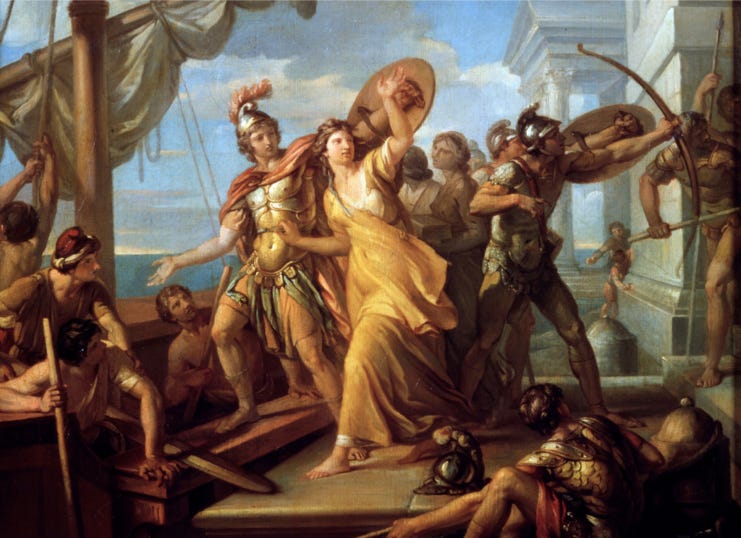
The war lasts 10 years and ends when the Greeks appear to retreat, leaving behind the gift of the famous Trojan Horse (a plot designed by Odysseus). Eagerly bringing the horse into the gates of Troy*, the unprepared warriors find it filled with Greek soldiers and the Trojans are defeated.
What about Helen? There are versions of mythology and in one, she is attracted to Paris and is happy to go with him, but in another, she is simply abducted and will be returned to her husband at the war’s end.
Breaking Down the Actions of the Characters
First, let’s have another look at Eris. A more modern view of her behavior shows the power of rattling the cage when justice is absent. I happened to be listening to a class on Eris the night when the news that Ruth Bader Ginsburg passed came in. Like many, I was saddened and worried about her loss. The presenter was taking questions, so I looked up her birth chart. I found she had Eris conjunct her Mercury in Aries, rising in her 1st house.
RBG was a major cage-rattler and responsible for many of the laws that boosted the equality of women in work, finance, ownership, etc.. And I have tracked the connections of Eris in other charts that have similar influences while Eris, still in Aries, is also currently active in our mundane charts of world events.
What did the ensuing competition show and what cages were rattled?
Venus/Aphrodite I was surprised to see a young woman blaming the Goddess of Love for the Trojan War. Her reasoning that Venus knew what a young man might go for reminds me of how women still accept unconscious abuse such as the usual female-blaming like: ‘she was wearing a short skirt and drinking too much,’ justification for rape. And of course, the other Goddesses are offering very big gifts that a young Prince might also go after.
In myths, Venus/Aphrodite is often vain and not always sweet and loving. And that shows up in this manipulation, but to blame her, we must also believe she knew she would be creating the war with this suggestion, which doesn’t appear to be the case. But she probably knew Paris already had a wife. But the competition does show that beauty can be vain and fight for compliments. That negative quality in the polarity of behaviors for Venus/Aphrodite is demonstrated by the two other goddesses, too.

Zeus
In one version of the myth, Zeus purposely ignites the party with discord as he wanted the war to cleanse the area of a proliferation of humans. In the more familiar version I gave, he shows up as a man-God who fears the power of his wife (Hera) if he doesn’t chose her, and of anyone who might challenge him (Eris).
Paris
But ultimately, Paris is the one that chooses…and chooses the method of capturing his prize, even though it may the cost the lives of the warriors who go with him and with no thought for Helen’s wishes or that a major war could be the result. Apparently, he already had a wife, too. And he certainly doesn’t imagine that he, himself, will perish.
So, he’s my choice for who is to blame for the war, even if the version of Zeus wanting the war makes him a manipulated toy.
And that’s my ‘judgement of Paris’. 😉
If you enjoy this post, I hope you will find the ❤️icon at the top or bottom and tap it to show your appreciation. Other ways are to Buy Me a Coffee ☕ or consider becoming a paid subscriber. Feel free to share or restack this post, too.
See you next time!
*Cassandra is the female prophet who urges them not to allow the horse into Troy. No one listens and that’s why many women whose true visions are not heard may say they have a “Cassandra Complex.”
Brilliant analysis here. The framing of Paris's choice as purely one of vanity misses how deeply geopolitical this whole judgement was from the start. Each goddess offered him forms of power, and Paris went for symbolic over strategic capital. I once had a teacher who compared the Judgment of Paris to modern leadership failures where short-term optics trump long-term consequence, which kinda stuck with me. If Sparta was already vulnerable to this sortof trigger, maybe the divine setup just acclerated inevitable conflict.
Blaming Venus for the Trojan War is like blaming Satan for you falling into temptation. There's culpability all around but the ultimate responsibility is with the one who takes the bait.